Connect with your florist: order flowers with delivery in thousands of towns and villages.
You can now also pay with Apple Pay or Google Pay.
As awareness of environmental issues grows globally, consumers are becoming increasingly demanding about companies’ transparency and eco-responsible practices, and the floral industry is no exception.
There is a growing recognition of the ecological footprint associated with traditional floristry, which often involves considerable water consumption, pesticide use, long-distance transport and significant waste, especially plastic. This global awareness is fueling a rising demand for more environmentally friendly alternatives, prompting a reassessment of practices across the entire industry.

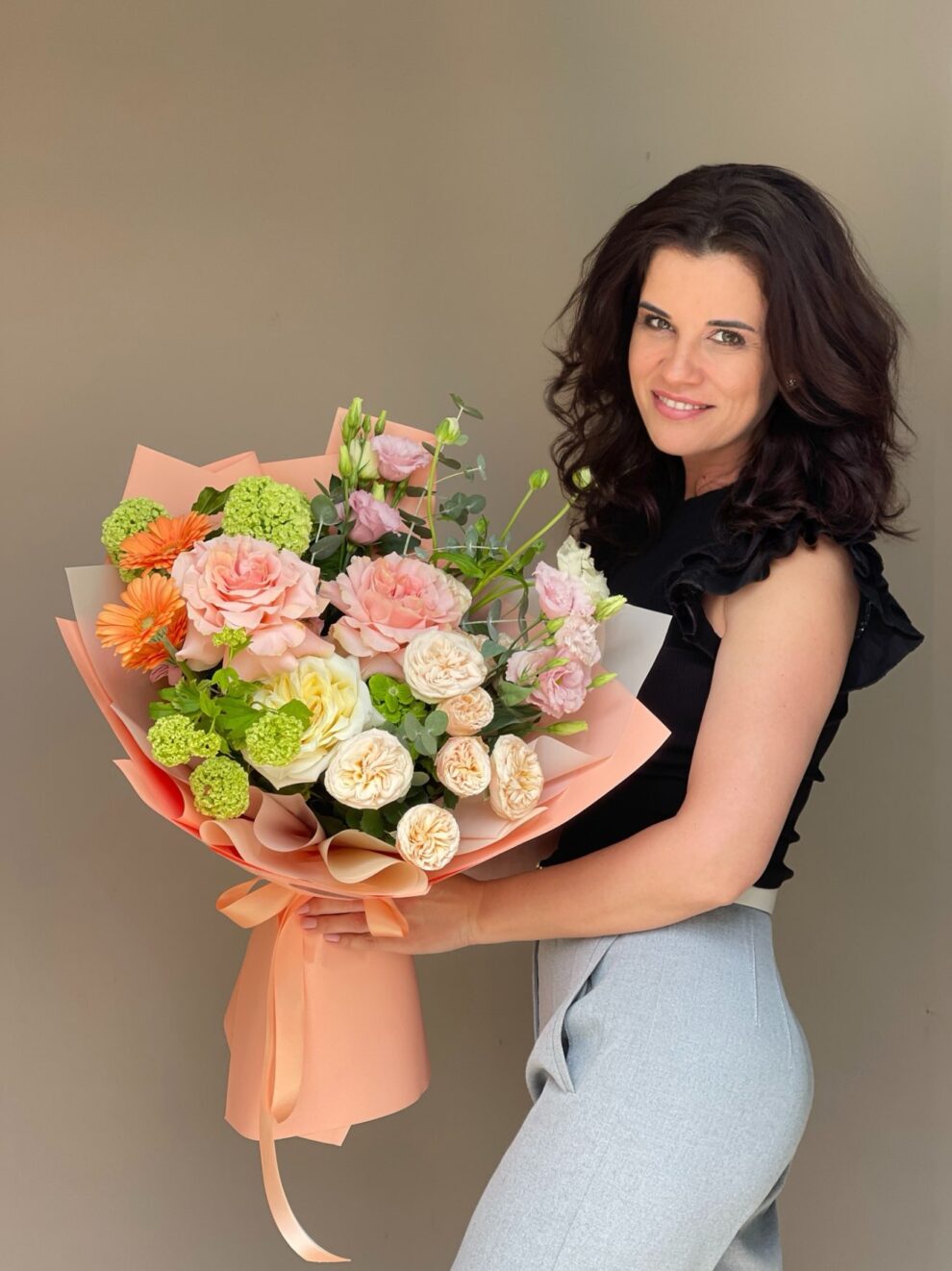
@Cristian Carapeț – Atelier CREA Constanța
Romania’s flower market has seen continuous growth in recent years, at least in the retail segment, where end consumers are buying flowers more and more often.
Even so, the local market is firmly dominated by imports, especially from the Netherlands, which account for roughly 90% of the cut flowers sold.
According to some estimates, the value of these Dutch imports reached around 100 million euros in 2023, suggesting an estimated total retail market value of about 120 million euros.
This heavy reliance on imports contrasts with the untapped potential of domestic production.
At the same time, the online sector has expanded remarkably, with roughly 30% of flower sales now taking place through digital channels – shops’ own websites or fast-delivery apps, a trend accelerated by the pandemic. Even boutique flower shops recognize the vital importance of an online presence for reaching customers.
Against this backdrop, numerous independent studios and flower shops stand out, often distinguished by their creativity and innovative approaches. A small share of these local businesses are beginning to adopt sustainability as a core value. Notable examples include Everbloom in Iași, the first in the Moldavia region to adopt eco-friendly practices, partly with the help of European funds. These initiatives signal an incipient but significant shift toward more responsible floristry in Romania.
In this dynamic landscape, the online platform Flov.ro has defined a clear mission: connecting customers with authentic flower shops in over 1,000 towns and villages across Romania, offering fast delivery (2-4 hours) and quality service.
Unlike models that centralize production or offer generic bouquets, Flov emphasizes the individuality and craftsmanship of each partner florist, supporting small local businesses in the process.
The platform also offers relevant content for the industry and consumers, including blog articles on a wide range of topics, from lifestyle to practical tips for florists.
Although the Flov platform does not explicitly promote sustainability as a central policy, its business model, built on partnerships with independent, authentic florists, inherently creates fertile ground for sustainable practices to flourish.
Many of these small, artisan businesses are the ones innovating and adopting eco-responsible approaches, as the examples mentioned above demonstrate.
By giving these pioneers a platform with national visibility, Flov becomes an indirect catalyst for sustainability. In practice, Flov makes it easier for consumers to reach the florists who choose to work responsibly, helping to increase the visibility and viability of these practices within its network.
Cristian Carapeț, founder of Atelier Crea – Plants & Flower design in Constanța, is one of the florists in the Flov network who has embraced sustainability as a fundamental principle.
His vision is clear: floral art can and must be practiced in a way that is conscious and responsible toward the environment. For Atelier Crea, adopting sustainable practices is not just a trend but a deliberate choice, an integral part of a more nature-friendly business model.
Atelier Crea’s commitment to sustainability translates into concrete, quantifiable actions that address multiple aspects of the shop’s ecological impact:
The following table summarizes the changes implemented by Atelier Crea compared with traditional practices:
Table: The sustainable changes implemented by Atelier Crea.
| Practice area | Traditional method | Atelier Crea’s sustainable approach | Key benefit |
| Arrangement mechanics | Floral foam (single-use plastic) | Kenzan, Wire Mesh, Moss, Reusable Vessels, Test Tubes (No Foam) | Avoids ~29kg of plastic waste (across 720 arrangements) |
| Flower sourcing | Heavy reliance on imports (Netherlands) | Prioritizes local/nearby growers; own propagation (roses) | Lower carbon footprint, supports the local economy |
| Waste management | Plant waste & packaging sent to landfill | Composting & recycling (3+ years); vessel reuse; encourages returns | Less waste, circularity |
| Packaging | Plastic film, single-use materials | Biodegradable kraft paper, reusable textiles; minimal/no-packaging option | Less plastic pollution |
| Customer interaction | Transactional | Sustainability education (recommendations, workshops, examples) | Raises awareness, stimulates demand |
For Cristian Carapeț and Atelier Crea, sustainability is not a checklist but a holistic approach woven into the ethos of the business. It is about creating beauty responsibly, mindful of the impact on the environment.
Hard data, such as the 720 foam-free arrangements and the roughly 29 kg of plastic avoided, offer tangible proof that sustainable floristry is not just an aspiration but a practical, measurable reality. These figures turn the abstract concept of “sustainability” into a concrete environmental benefit, providing a strong argument against skepticism and showing other florists that the transition is possible and has a real impact.
Adopting sustainable practices can seem daunting at first, but there are plenty of techniques and alternatives within reach of florists in Romania.
The floral foam problem deserves special attention because of its persistent negative impact.
As a non-biodegradable plastic, it contributes to microplastic pollution and contains toxic chemicals. Even the versions labeled “biodegradable” often require specific industrial composting conditions that ordinary landfills never reach, making the claim misleading for the average consumer.
Fortunately, the alternatives are varied and effective:
Choosing the right alternative depends on the style of the arrangement and the type of flowers, but creativity and mastering the techniques can overcome any perceived difficulty. The example of the 2018 British royal wedding, where only eco-friendly alternatives were used, proves these methods are viable even at the highest level.
Prioritizing local, seasonal flowers is fundamental to reducing the carbon footprint. Short transport distances, greater freshness, support for local growers and the chance to offer arrangements with a unique regional character are major advantages.
The challenge in Romania lies in the structural dependence on imports, which makes sourcing exclusively locally all year round difficult. Strategies for navigating this reality include:
Beyond the obvious ecological benefits, focusing on local sources can also make a business more resilient. In a world of increasingly volatile global supply chains, excessive dependence on imports exposes florists to price fluctuations and potential disruptions. Diversifying through local suppliers, even partially, is not just an ethical choice but a strategic one, capable of mitigating risks and strengthening the long-term stability of the business.
The “zero waste” approach is an ideal flower shops can work toward through multiple strategies:
Reducing water consumption is another important facet of sustainability. Florists can contribute by:
Transparent communication with customers is crucial for promoting and validating sustainable practices. Florists can:
At the same time, customers can be encouraged to make informed choices: to ask for foam-free arrangements, to inquire about where the flowers come from, to prefer local growers and to opt for minimal or reusable packaging.
The transition to sustainable floristry in Romania is a collective effort that requires the involvement of everyone in the industry.
Knowledge sharing and mutual support are vital. Online communities such as the VreauFlorarie.ro forum, which has sections dedicated to sustainability and ecological practices, offer a valuable space for discussion and learning. Individual initiatives, such as publishing sustainability reports or the ambition to build a community of eco-minded florists and growers, demonstrate leadership and inspire action. Workshops and training courses also play an essential role in spreading the techniques and knowledge needed for the transition to greener practices.
The transition is not without obstacles. Sustainable materials can sometimes carry a higher upfront cost, although reusable alternatives can bring long-term savings.
Deeply rooted habits, such as the reliance on floral foam, can be hard to change, requiring conscious effort and adaptation. Consumer awareness, though growing, may still call for sustained education. Overcoming these challenges takes creativity, perseverance and a clear will to adopt new ways of working.
Sustainability in Romanian floristry is no longer just an ethical imperative – it is increasingly becoming an engine of innovation, differentiation and resilience. Pioneers such as Atelier Crea Constanța and Everbloom Iași prove that it is possible to create impactful floral art, full of beauty and emotion, in a way that is deeply responsible toward the planet.
The future of the floral industry belongs to those who embrace change and recognize the long-term value of sustainable practices.
It takes a concerted effort from florists, platforms like Flov, suppliers and consumers to cultivate a floral ecosystem that is healthier, more authentic and more respectful of natural resources.
By choosing sustainability, Romania’s floral industry not only reduces its negative impact but can also strengthen its identity, support local communities and offer products and experiences of genuine value to its customers.
The road is open, and the potential for a sustainable industry is immense.


